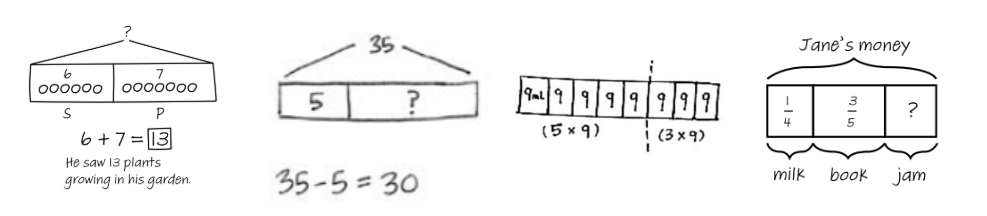
When supporting your child with problem solving at home, you can ask them the following questions: What do you visualize? Can you draw and label something to represent the problem? What conclusions can I make from my drawing?
Encouraging your child to draw before jumping straight to an answer builds strong problem-solving habits that will support them across all math topics.
The final step in our Read–Draw–Write problem-solving process is the Write portion. By the time students get to this step, they have already read the problem carefully and drawn a picture or model to represent their thinking. Now it’s time to put their understanding into words.
In the Write step, students complete an answer statement. This means they don’t just give a number, they explain their answer in a full sentence. Writing helps students make sure they are answering the question that was actually asked.
For example, instead of writing: 12 Students write: There are 12 apples in the basket.
This may seem simple, but it is an important part of learning. The Write part of the process helps students:
Check that their answer makes sense
Connect their drawing to the math they solved
Practice using math vocabulary
Clearly communicate their thinking
Answer statements look different depending on grade level.
In Kindergarten and first grade, teachers provide sentence frames like:
“There are ___ apples in all.” Students fill in the blank with the correct number.
As students grow, they begin completing sentence frames on their own.
Eventually, students write their own answer statements independently.
This gradual process builds confidence and helps students become strong problem solvers—not just students who can compute an answer, but students who truly understand what the numbers mean.
When you see your child writing a full sentence to answer a math problem, know that this small step is helping build big thinking skills!